At OptimumT, we treat Medical Device Software (MDS) as a mission-critical discipline. We bridge the gap between cutting-edge Agentic AI and the rigorous safety standards required for clinical validation. Our MDS toolchain is designed to be Safe by Design, ensuring that autonomous logic never bypasses clinical guardrails.
Our Core MDS Framework
1. Lifecycle Management (IEC 62304)
We adhere to the international standard for the lifecycle requirements of medical device software. Every line of code is part of a documented journey from requirement to verification.
Risk Categorization: Specialized processes for Class II and Class III software safety classifications.
Traceability: Full bidirectional traceability between clinical requirements, risk analysis, and unit testing.
2. Software Risk Management (ISO 14971)
For Agentic AI to enter the operating theater, risk must be deterministic. We integrate Failure Mode and Effects Analysis (FMEA) directly into our software architecture.
Hazard Identification: Identifying potential software anomalies before they reach the hardware layer.
Mitigation Logic: Hardcoded “Safe States” that trigger automatically if the AI’s confidence interval falls below clinical thresholds.
3. Cybersecurity & Data Integrity
Medical devices are increasingly networked. Our MDS approach prioritizes Defense-in-Depth to protect patient data and device functionality.
SOUP Management: Rigorous auditing of “Software of Unknown Provenance” (Open-source libraries) to ensure no vulnerabilities enter the clinical loop.
The OptimumT Edge: “Clinical Agency”
We don’t just build software; we build Verified Clinical Intelligence.
Deterministic Guardrails: Our software uses formal methods to prove that robotic tool movements remain within a pre-defined “Safe Volume.”
Audit-Ready Documentation: We provide automated documentation pipelines that generate the technical files required for FDA 510(k) or EU MDR submissions.
Human-in-the-loop (HITL): Our MDS interfaces are designed to augment, not replace, the clinician, providing high-fidelity data visualization that reduces cognitive load during complex procedures.
The OptimumT Edge: Proven in High-Consequence Environments
Our architectural philosophy was forged in high-consequence, real-time data environments where sub-millisecond latency and 100% uptime are the baseline. By applying this same rigor to Medical Device Software, we provide a level of responsiveness and reliability that legacy systems cannot match.
Beyond Reactive Systems: While legacy medical software often relies on static, rule-based triggers, our Reasoning Core anticipates environmental shifts, allowing for smoother tool stabilization and more intuitive user interfaces.
Edge-Native Reliability: Our experience with high-volume telemetry ensures that our MDS layers are optimized for local compute, reducing dependency on external networks and eliminating the latency risks inherent in cloud-reliant solutions.
Deterministic Agility: We replace “black box” complexity with deterministic toolchains, ensuring that even as the system adapts to real-time clinical data, it remains strictly within the bounds of its verified safety envelope.
Safety & Quality Policy
Statement of Clinical Integrity & Regulatory Commitment
At OptimumT, our commitment to patient safety is foundational to our engineering ethos. We operate under a rigorous Quality Management System (QMS) designed to meet and exceed international standards for medical device software.
Compliance Framework: All software development is conducted in strict accordance with IEC 62304 (Lifecycle) and ISO 14971 (Risk Management).
Verification-First Culture: We employ formal methods and automated testing suites to ensure that every software release is verified against its clinical requirements and validated for its intended use.
Continuous Risk Mitigation: Our “Closed-Loop” safety architecture ensures that at any point of uncertainty—whether through sensor degradation or environmental anomaly—the system defaults to a pre-defined Safe State, prioritizing human life above autonomous continuity.
Post-Market Vigilance: We maintain active surveillance protocols to monitor software performance in real-time, ensuring that any drift in accuracy is identified and mitigated before it impacts clinical outcomes.
OptimumT is committed to the transparent, ethical, and safe deployment of intelligence in the medical theater. Our systems are built to assist, protected to preserve, and verified to perform.
Is Your AI Ready for Surgery? The YOLO-NAS Revelation
Is Your AI Ready for Surgery? The YOLO-NAS Revelation
At OptimumT, we’re on a mission to push the boundaries of AI, especially where it matters most – saving lives. We’ve all seen the headlines about groundbreaking AI models, boasting incredible performance in labs and on massive public datasets. But what happens when these “State-of-the-Art” models face the gritty, unpredictable reality of critical applications like Computer-Aided Laparoscopy (CAL)? A recent study, “Performance Analysis of YOLO-NAS SOTA Models on CAL Tool Detection”, dives deep into this very question, and the results are a powerful wake-up call for the entire AI community! The Hype vs. Reality Check for YOLO-NAS You’ve probably heard […]
Transforming Surgery with AI: Unleashing the Power of YOLOv8 for Instrument Detection!
Transforming Surgery with AI: Unleashing the Power of YOLOv8 for Instrument Detection!
At OptimumT, we are committed to harnessing the power of artificial intelligence to transform the healthcare landscape. Our latest research, titled “Cholecystectomy Surgical Instrument Detection Using Variants of YOLOv8,” marks a significant milestone in our journey to enhance surgical precision and efficiency through advanced technology. The article was recently published in the recent proceedings of the prestigious Irish Signals and Systems Conference (ISSC), 2024. Here is another link to our work. Here is the corresponding oral presentation of this work. The Challenge in Modern Surgery Surgery is an intricate and demanding field that requires not only exceptional skill but also […]
Democratized AI Vision as a Labor Day Gift to Humanity: From Powerful GPUs to Battery-Powered Robots
Democratized AI Vision as a Labor Day Gift to Humanity: From Powerful GPUs to Battery-Powered Robots
At OptimumT, we are proud to highlight groundbreaking research that pushes the boundaries of computer vision and AI — the creation of a lightweight, highly efficient CNN-based network for real-time interest point detection and description, as detailed in the recent study on the R2D2 network. Why is this so critical? Interest point detection and description is foundational to robotics, enabling applications like Simultaneous Localization and Mapping (SLAM), camera calibration, obstacle avoidance, and trajectory planning. Traditionally, these systems demanded powerful GPUs and consumed too much energy for real-time use on embedded or battery-powered devices like robotic vacuum cleaners, drones, or AR […]
Revolutionizing Surgery: The Future of Computer-Aided Laparoscopy with NeuroEvolution of Capsule Networks
Revolutionizing Surgery: The Future of Computer-Aided Laparoscopy with NeuroEvolution of Capsule Networks
In the realm of medical technology, the intersection of artificial intelligence and surgical robotics is paving the way for groundbreaking advancements. At the forefront of this revolution is the innovative research presented in the paper “NeuroEvolution of Capsule Networks for Computer-Aided Laparoscopy.” This cutting-edge study explores how neuroevolutionary techniques can enhance the capabilities of capsule networks, ultimately transforming the landscape of laparoscopic surgery. The Challenge: A Growing Need for Surgical Precision Every year, approximately 330 million surgeries are performed globally, yet a staggering backlog of 150 million surgeries remains pending. As the demand for surgical procedures continues to rise, the […]
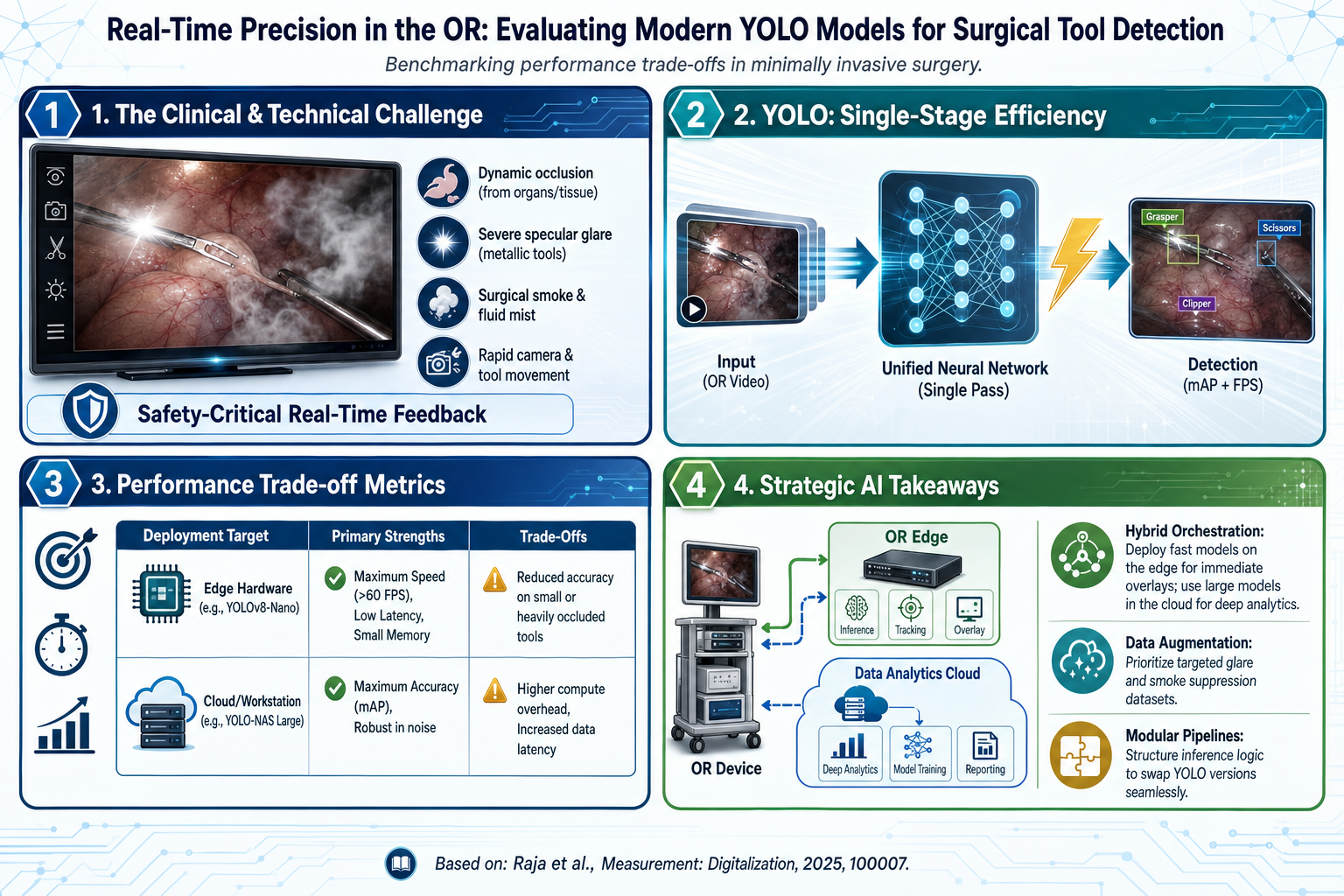
Real-Time Precision in the Operating Room: Evaluating Modern YOLO Models for Laparoscopic Surgery
Real-Time Precision in the Operating Room: Evaluating Modern YOLO Models for Laparoscopic Surgery
In computer-assisted surgery, split-second accuracy isn’t just a technical metric—it is a patient safety requirement. Minimally invasive procedures like laparoscopic cholecystectomy (gallbladder removal) rely increasingly on AI-driven computer vision to identify surgical tools in real time. This case study evaluates how recent iterations of the YOLO (You Only Look Once) object detection family balance inference speed, memory efficiency, and detection accuracy under complex surgical conditions. 1. The Clinical & Technical Challenge Modern Operating Rooms (ORs) are evolving into connected digital ecosystems. Automated tracking of surgical tools (e.g., grasper, scissors, hook cautery, clipper) enables high-value clinical applications: Workflow Phase Recognition: Automatically logging […]
Real-Time Precision in the Operating Room: Evaluating Modern YOLO Models for Laparoscopic Surgery
Real-Time Precision in the Operating Room: Evaluating Modern YOLO Models for Laparoscopic Surgery
In computer-assisted surgery, split-second accuracy isn’t just a technical metric—it is a patient safety requirement. Minimally invasive procedures like laparoscopic cholecystectomy (gallbladder removal) rely increasingly on AI-driven computer vision to identify surgical tools in real time. This case study evaluates how recent iterations of the YOLO (You Only Look Once) object detection family balance inference speed, memory efficiency, and detection accuracy under complex surgical conditions. 1. The Clinical & Technical Challenge Modern Operating Rooms (ORs) are evolving into connected digital ecosystems. Automated tracking of surgical tools (e.g., grasper, scissors, hook cautery, clipper) enables high-value clinical applications: Workflow Phase Recognition: Automatically logging […]
To provide the best experiences, we use technologies like cookies to store and/or access device information. Consenting to these technologies will allow us to process data such as browsing behavior or unique IDs on this site. Not consenting or withdrawing consent, may adversely affect certain features and functions.
Functional
Always active
The technical storage or access is strictly necessary for the legitimate purpose of enabling the use of a specific service explicitly requested by the subscriber or user, or for the sole purpose of carrying out the transmission of a communication over an electronic communications network.
Preferences
The technical storage or access is necessary for the legitimate purpose of storing preferences that are not requested by the subscriber or user.
Statistics
The technical storage or access that is used exclusively for statistical purposes.The technical storage or access that is used exclusively for anonymous statistical purposes. Without a subpoena, voluntary compliance on the part of your Internet Service Provider, or additional records from a third party, information stored or retrieved for this purpose alone cannot usually be used to identify you.
Marketing
The technical storage or access is required to create user profiles to send advertising, or to track the user on a website or across several websites for similar marketing purposes.